
Quick answer: Shoegaze Full Track
クイック回答
A strong 8-minute shoegaze track usually sits around 90–110 BPM, stacks soft drums under saturated guitars, and uses long reverb/delay returns so the arrangement can breathe without a constant vocal hook.
What Makes Shoegaze Feel Like Shoegaze
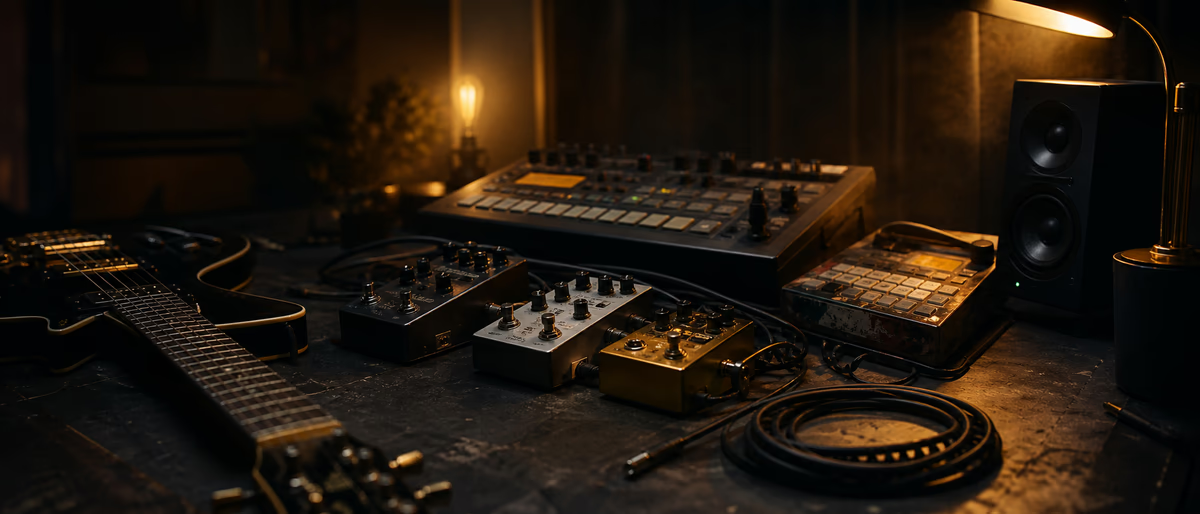
Shoegaze is less about a single riff and more about density, blur, and emotional sustain. Classic bands treated guitars as atmosphere engines—heavy pedals, feedback, and mix decisions that bury the edge of each note inside a cloud. The genre name itself comes from performers staring at their pedalboards while walls of sound filled the room.[1]
For an eight-minute runtime you need more architecture than a two-minute beat loop. Think in movements: introduction haze, pulse establishment, harmonic lift, mid-track thinning, return of the wall, and a long dissolve. If every section is equally loud and busy, the track will feel like one block stretched with a loop tool.
Modern shoegaze-adjacent production also borrows from dream pop, slowcore, and ambient techno. You can use programmed drums and soft 808-style subs, but they should support the wash rather than fight it. Keep transients rounded and avoid trap-style hi-hat spam unless you are deliberately hybridizing.
Tempo, Key, and Sound Palette
| Element | Starting range | Notes |
|---|---|---|
| Tempo | 90–110 BPM | Slower feels heavier; faster drifts toward dream-pop indie |
| Key | E minor / D major / F# minor | Open-string friendly guitar keys |
| Drum feel | Four-on-floor soft or half-time | Low velocity, long room reverb |
| Guitar layers | 4–10 mono/stereo pairs | Different pedals per layer |
| Bass | Sustained root + octave | Avoid busy funk lines |
| Vocal (optional) | Soft, distant, doubled | Often lower in the mix than pop |
Pick one center key and stay there longer than you would in pop. Shoegaze harmony often changes slowly—modal vamps, suspended chords, and parallel major/minor color shifts work better than rapid jazz changes. If you introduce a key change, place it near the five-minute mark so the second half feels like a new room, not a random modulation.
Build a palette board before sequencing: two clean amps, one fuzz, one chorus/flange, one reverse-reverb guitar, one pad synth doubling the chord roots, and a noise bed (tape hiss, room tone, vinyl crackle at low level). Limiting the palette prevents the eight-minute form from becoming a plugin demo reel.
Building the Guitar Wall
- Layer roles Assign each guitar a job: low rhythm bed, mid shimmer, high ice, feedback swell, reverse ear-candy. If two layers share the same EQ peak and stereo width, they will phase into mud.
- Pedal order sketch Drive → modulation → delay → reverb is a common chain. For shoegaze, many producers put a short ambient reverb before a longer hall so notes smear before the big space.
- Stereo tactics Double-track or hard-pan complementary layers. Keep one mono center guitar so the wall has a spine when headphones collapse the sides.
- Feedback & swell Automate volume pedals or utility gain for bow-like swells into chorus hits. Record actual amp feedback if you can; sample it and pitch it down an octave for under-rumble.
- DI + amp blend Keep a dry DI under heavy amp sims so you can re-amp or rebalance midrange later without rebuilding the entire stack.
Route long time-based effects to return tracks rather than printing ten reverbs on every clip. Shared returns glue the wall and save CPU on long sessions.[3] A practical Ableton or FL setup is: Return A short plate (0.8–1.4 s), Return B large hall/shimmer (3–8 s), Return C tape delay dotted-eighth with low feedback, Return D lo-fi noise wash.
High-pass most guitar returns around 120–180 Hz so the sub stays reserved for bass and kick. Low-pass a few decorative layers under 8–10 kHz to keep air for cymbals or vocal breath. Shoegaze should feel wide, not harsh.
Drums and Bass Under the Haze
Program drums softer than hip-hop defaults. Kick: short, mid-forward, not clicky EDM. Snare/clap: brush, rim, or muffled snare with long reverb send. Hats: sparse; try 8th notes with velocity decay instead of 1/16 rolls. Toms and rides can carry movement when guitars hold static chords.
Sidechain the guitar bus lightly to the kick (1–3 dB) if the low mids pump. Do not duck the entire mix into a club pulse unless you want shoegaze-techno hybrid. Bass can be a sustained synth under the root or a DI bass with mild chorus; leave space at 200–400 Hz where guitars already live.
For an eight-minute piece, invent two drum states: State A (half-time, wide room) for verses/haze and State B (straight 4/4, drier) for lifts. Switching states is cheaper emotionally than writing entirely new drum songs every section.
Eight-Minute Arrangement Map
Mark section locators in your DAW and bounce rough 30-second reference clips of each movement. Listening on phone speakers quickly reveals whether the mid-track dip actually drops energy or only removes one plugin. If the four-minute mark still feels like bar one, rewrite transitions before polishing tones.
Leave true-peak headroom for streaming. Spotify’s normalization pipeline is a reminder that crushing the master will not buy emotional impact—dynamics and arrangement do more for long tracks than another decibel of limit.[2]
Mix Notes for Dense Shoegaze
- Midrange triage Carve 300–600 Hz on the muddiest guitar layers; boost presence on one hero layer only.
- Width control Keep bass/kick mono below ~120 Hz. Use mid/side EQ to tame harsh side cymbals.
- Reverb pre-delay 15–40 ms pre-delay keeps pick attack readable before the wash arrives.
- Bus saturation Gentle tape or transformer color on the guitar bus can glue layers better than stacking more distortion plugins.
- Reference method Level-match a commercial shoegaze reference and A/B every 10 minutes; long sessions bias you toward endless brightness.
Mastering an eight-minute shoegaze track benefits from section-aware automation: slightly lower limiter threshold during the densest wall so the dissolve can bloom again without pumping. True peak ceiling around −1 dBTP is a safe delivery habit for multi-platform encoding.
Export a continuous master and a radio edit only if you truly need one. Many playlist and Bandcamp listeners accept long form; forced two-minute chops often kill the genre’s pacing.
Finishing Checklist
If you sample other records, clear what you must and document sources. Shoegaze culture loves texture, but platforms do not care about aesthetic intent when Content ID claims hit. Prefer self-recorded amps, field recordings, and licensed packs when the track is commercial.
Need guitars, pads, and ambient one-shots for walls of sound? Browse verified sample packs and free tools on Plugg Supply, then upgrade when you need on-demand processing.
Learning path
関連アンサーハブ
関連カタログ
カタログのさらなるチュートリアル
Plugg Supplyフィードのさらなるチュートリアル。カタログ人気順。
![Truefire Integrating Percussive Techniques with Rhythm (JamPlay) [TUTORiAL]](/images/posts/truefire-integrating-percussive-techniques-with-rhythm-jampl-86170.avif?v=2026080101)
LEARNING / VIDEO TUTORIALS
Truefire Integrating Percussive Techniques with Rhythm (JamPlay) [TUTORiAL]
![Music Hackspace Abstract Composition in Ableton and by Ned Rush [TUTORiAL]](/images/posts/music-hackspace-abstract-composition-in-ableton-and-by-ned-r-86165.avif?v=2026080101)
LEARNING / VIDEO TUTORIALS
Music Hackspace Abstract Composition in Ableton and by Ned Rush [TUTORiAL]
![Truefire Modern Country Rhythm [TUTORiAL]](/images/posts/truefire-modern-country-rhythm-86151.avif?v=2026080101)
LEARNING / VIDEO TUTORIALS
Truefire Modern Country Rhythm [TUTORiAL]
![MixWithTheMasters Andrew Watt In The Stars The Rolling Stones [TUTORiAL]](/images/posts/mixwiththemasters-andrew-watt-in-the-stars-the-rolling-stone-86129.avif?v=2026080101)
LEARNING / VIDEO TUTORIALS
MixWithTheMasters Andrew Watt In The Stars The Rolling Stones [TUTORiAL]
関連記事
LEARNING / VIDEO TUTORIALS
Truefire Integrating Percussive Techniques with Rhythm (JamPlay) [TUTORiAL]
LEARNING / VIDEO TUTORIALS
Music Hackspace Abstract Composition in Ableton and by Ned Rush [TUTORiAL]
LEARNING / VIDEO TUTORIALS
Truefire Modern Country Rhythm [TUTORiAL]
LEARNING / VIDEO TUTORIALS
MixWithTheMasters Andrew Watt In The Stars The Rolling Stones [TUTORiAL]
![Music Hackspace Getting Started With Interactivity With Max by Kyle Duffield [TUTORiAL]](/images/posts/music-hackspace-getting-started-with-interactivity-with-max--86081.avif?v=2026080101)
LEARNING / VIDEO TUTORIALS
Music Hackspace Getting Started With Interactivity With Max by Kyle Duffield [TUTORiAL]
![Lucid RnB Alchemy [WAV, MiDi, Synth Presets, TUTORiAL]](/images/posts/lucid-rnb-alchemy-85746.avif?v=2026080101)
サンプル / プリセット / MIDI / VIDEO TUTORIALS
トップ 2%Lucid RnB Alchemy [WAV, MiDi, Synth Presets, TUTORiAL]
よくある質問
- What BPM is best for shoegaze?
- Most tracks land between 90 and 110 BPM. Slower tempos emphasize weight and reverb tails; slightly faster tempos lean dream-pop. Pick one tempo and commit for the full eight minutes unless a half-time illusion is part of the arrangement.
- How many guitar layers do I need?
- Four strong layers with distinct EQ and stereo roles often beat ten redundant ones. Add layers only when each has a new frequency, rhythm, or spatial job.
- Should shoegaze vocals be loud?
- Usually no. Vocals often sit inside the wall—intimate, doubled, and less bright than pop leads. Raise them only if the song’s lyric narrative needs clarity.
- Can I make shoegaze without real guitars?
- Yes. Amp-sim plugins, granular pads, and resampled chords can approximate the wall. Record at least some physical noise (room, cable, amp hiss) so the result does not sound purely synthetic.
- How do I stop the mix from getting muddy?
- High-pass decorative layers, share reverb returns, carve competing midrange, and thin the arrangement mid-track. Mud is usually arrangement density plus unfiltered reverb, not a single EQ preset.
- What is a good length structure for 8 minutes?
- Use a two-act form with a deliberate dip around the middle, a denser second-act wall, and a long dissolve. Continuous full density for eight minutes almost always fatigues listeners.
- Do I need expensive reverb plugins?
- No. Stock algorithmic reverbs plus careful pre-delay, EQ on returns, and automation are enough. Boutique reverbs help, but routing discipline matters more.
- How loud should I master for streaming?
- Aim for competitive but not crushed levels, leave about −1 dBTP true-peak headroom, and prioritize section dynamics over maximum integrated LUFS.