
ローカルな文脈
AI 音楽、音声、カバーアート、学習データ、開示に関するルールは管轄とプラットフォームによって異なります。この記事はワークフローの概要であり、法的助言ではありません。
行動する前に、お住まいの国の現地法、支払い方法、プラットフォームの利用可否、税金、音楽権利の管理を確認してください。
クイック回答
You can often use AI-assisted album artwork if your tool license permits commercial use, the image does not copy protected art or a real person, and you disclose AI involvement when a store, ad platform, label, or marketplace asks. Copyright protection may be weaker for prompt-only artwork, so keep human design edits and source records.
Short answer for producers
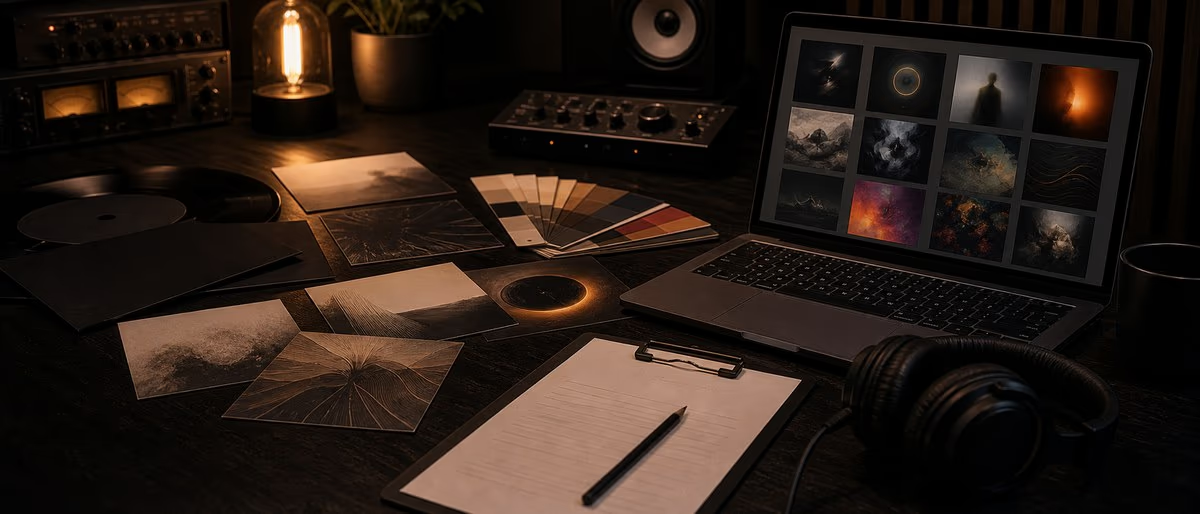
AI album artwork is safest when it is treated as a commissioned design asset, not a magic replacement for rights clearance. The hard questions are not only copyright: they include artist likeness, trademarked logos, misleading style mimicry, consumer disclosure, and whether the artwork is protectable enough to build a brand around.
This is practical publishing and platform-risk guidance, not legal advice. If a release depends on a major fee, exclusive license, sync placement, impersonation question, or disputed catalog, get jurisdiction-specific legal review before upload.
The safest pattern is simple: use AI as an assistive production tool, keep human creative control visible, avoid impersonation or unlicensed source material, disclose AI use when asked, and save evidence of every license, consent, prompt, edit, and export.
Regional rights and disclosure map
AI music policy is not global. Copyrightability, personality and voice rights, disclosure duties, consumer rules, platform terms, and data or training obligations vary by territory and by the role you play: artist, producer, distributor, label, tool provider, or dataset owner.
Use this map as a routing checklist before localizing metadata, ads, cover art, lyrics, vocal claims, or catalog terms.
| Market | Producer-safe reading |
|---|---|
| US | Human authorship remains central for copyright claims. Voice and likeness risk is handled through state publicity, unfair competition, contracts, and platform rules. Disclose AI when the platform, distributor, ad partner, or copyright filing asks for it. |
| EU/EEA/UK | Expect stricter transparency, consumer protection, data protection, and AI Act/GPAI duties around training summaries, synthetic media labels, and rights reservations. UK rules are not identical to EU rules, so treat them separately for commercial releases. |
| China | Generated or synthetic text, image, audio, and video services face explicit and implicit labeling expectations. Platforms can be stricter than copyright law, especially for voice, celebrity, news, and consumer-facing content. |
| Japan/Korea | Text-and-data-mining, training, copyrightability, and performer/personality questions are evolving differently. Do not assume a model trained legally in one market is safe to commercialize in another. |
| Brazil | Copyright, consumer protection, personality rights, LGPD privacy rules, and AI-policy proposals can all matter for voice, image, fan-facing disclosure, and dataset handling. |
| Russia | Copyright and personal non-property rights can apply differently from US/EU assumptions. Keep licenses, permissions, and platform evidence in Russian-market campaigns. |
| Turkey/Indonesia | Local copyright, advertising, consumer, data, and morality/public-order rules can affect synthetic voice, AI artwork, and monetized platform uploads. Use conservative disclosure when targeting these markets. |
| Spanish/Arabic-language markets | Do not treat language as a single legal zone. Spain, Mexico, Argentina, Colombia, Gulf states, Egypt, Saudi Arabia, and North Africa differ on copyright, moral rights, publicity, privacy, and consumer disclosure. |
Release-safe AI cover art workflow
- Start with licensed tools
Use a generator or model whose current terms allow commercial cover art, paid advertising, merchandise, and territory-wide distribution if those uses matter. - Avoid real-person prompts
Do not prompt for a living artist, celebrity, photographer, label artwork style, or a confusingly similar face unless you have written permission. - Add human design work
Use layout, typography, color correction, compositing, retouching, and art direction that can be documented as your creative contribution. - Run a similarity pass
Reverse-image search the final cover, check for logos and watermarks, and reject outputs that resemble known albums or copyrighted illustration. - Save disclosure evidence
Keep tool terms, prompt history, source files, final layered files, and upload screenshots showing any AI label or checkbox used.
Rights checklist
- Commercial-use license The AI tool and any stock or font assets must cover streaming stores, YouTube thumbnails, ads, physical products, and merch if you plan to use them.
- Copyright strength Prompt-only images may be difficult to register in some places. Human selection, arrangement, retouching, and typography can strengthen the protectable layer.
- Likeness and publicity A synthetic face can still create risk if listeners think it depicts a real person, artist, model, or public figure.
- Platform disclosure Stores, ad networks, marketplaces, and social platforms can require synthetic-media disclosure even when copyright law is silent.
Common risk points
| Risk | Why it matters | Conservative move |
|---|---|---|
| Famous album lookalike | Trade dress and consumer confusion can matter even without exact copying. | Change composition, typography, colors, and title treatment until it is clearly your own. |
| Fake portrait | Personality, privacy, and deceptive endorsement claims can travel across markets. | Use licensed models, self-owned photos, or clearly fictional stylized characters. |
| Weak copyright claim | Some offices may refuse registration for material generated without human authorship. | Document design choices and register only the human-authored elements where required. |
| Hidden watermarks or signatures | Model outputs can contain artifacts that imply copied source art. | Inspect at full resolution and reject suspicious generations. |
Documentation to keep
- Tool terms at time of export Save the plan page, commercial-use clause, model/version notes, and any AI disclosure policy that applied when you generated or exported the asset.
- Human contribution record Keep DAW sessions, stems, MIDI, lyrics drafts, arrangement notes, mix revisions, and screenshots that show creative control beyond a prompt.
- Source and consent trail Archive sample licenses, vocalist releases, artwork permissions, cover-song licenses, opt-out notices, takedown responses, and distributor correspondence.
- Market-specific upload notes Record which territories were targeted, which metadata fields mentioned AI, and which platforms required labels, checkboxes, or synthetic-media declarations.
Explore verified production resources on Plugg Supply.
Learning path
関連アンサーハブ
関連カタログ
カタログのさらなるチュートリアル
Plugg Supplyフィードのさらなるチュートリアル。カタログ人気順。
![Truefire Integrating Percussive Techniques with Rhythm (JamPlay) [TUTORiAL]](/images/posts/truefire-integrating-percussive-techniques-with-rhythm-jampl-86170.avif?v=2026080101)
LEARNING / VIDEO TUTORIALS
Truefire Integrating Percussive Techniques with Rhythm (JamPlay) [TUTORiAL]
![Music Hackspace Abstract Composition in Ableton and by Ned Rush [TUTORiAL]](/images/posts/music-hackspace-abstract-composition-in-ableton-and-by-ned-r-86165.avif?v=2026080101)
LEARNING / VIDEO TUTORIALS
Music Hackspace Abstract Composition in Ableton and by Ned Rush [TUTORiAL]
![Truefire Modern Country Rhythm [TUTORiAL]](/images/posts/truefire-modern-country-rhythm-86151.avif?v=2026080101)
LEARNING / VIDEO TUTORIALS
Truefire Modern Country Rhythm [TUTORiAL]
![MixWithTheMasters Andrew Watt In The Stars The Rolling Stones [TUTORiAL]](/images/posts/mixwiththemasters-andrew-watt-in-the-stars-the-rolling-stone-86129.avif?v=2026080101)
LEARNING / VIDEO TUTORIALS
MixWithTheMasters Andrew Watt In The Stars The Rolling Stones [TUTORiAL]
関連記事
LEARNING / VIDEO TUTORIALS
Truefire Integrating Percussive Techniques with Rhythm (JamPlay) [TUTORiAL]
LEARNING / VIDEO TUTORIALS
Music Hackspace Abstract Composition in Ableton and by Ned Rush [TUTORiAL]
LEARNING / VIDEO TUTORIALS
Truefire Modern Country Rhythm [TUTORiAL]
LEARNING / VIDEO TUTORIALS
MixWithTheMasters Andrew Watt In The Stars The Rolling Stones [TUTORiAL]
![Music Hackspace Getting Started With Interactivity With Max by Kyle Duffield [TUTORiAL]](/images/posts/music-hackspace-getting-started-with-interactivity-with-max--86081.avif?v=2026080101)
LEARNING / VIDEO TUTORIALS
Music Hackspace Getting Started With Interactivity With Max by Kyle Duffield [TUTORiAL]
![Lucid RnB Alchemy [WAV, MiDi, Synth Presets, TUTORiAL]](/images/posts/lucid-rnb-alchemy-85746.avif?v=2026080101)
サンプル / プリセット / MIDI / VIDEO TUTORIALS
トップ 2%Lucid RnB Alchemy [WAV, MiDi, Synth Presets, TUTORiAL]
よくある質問
- Can I use AI-generated cover art on Spotify and Apple Music?
- Usually yes through your distributor if the tool license allows commercial use and the image does not infringe or deceive. Follow any distributor disclosure fields and keep the license record.
- Can I copyright prompt-only cover art?
- In many places, protection is uncertain or limited without human authorship. Protect your typography, layout, edits, and brand assets separately when possible.
- Do I need to say the cover was made with AI?
- Say so when a platform, ad partner, label, marketplace, contest, or local rule asks. Voluntary disclosure can also reduce fan backlash when the use is material.
- Is it safe to ask for art in a famous illustrator style?
- It is safer to describe visual qualities without naming a living artist, album, label campaign, or protected character. Style prompts can create reputational and legal risk.